

I used to be pretty blasé about swans, but a few days ago a serene afternoon dip turned into a trip to A&E, stitches to my head and a CT scan and I have a newfound respect for them.
I was breaststroking around in my usual river pool in Somerset and the cob whirred in with a hiss. Usually I just back off, and they go away, but this time there were some children also swimming, so I held my ground a bit, and kept an eye on him.
It was the male (cob) swan, of course, guarding his territory and, although the cygnets were nowhere in sight, I did know there might be nests along this stretch and it is the cygnet season. I know they like to keep fairly wide authority to ensure no predators or competitors come into their zone. I have a respect for swans, and know they are wild and can be vicious: I had seen them wantonly kill ducklings on the river before, and had heard about them trying to ‘duck’ a swimming dog long enough to drown it. I had also heard about them being able to ‘break your arm with their wing’ but although they are strong, I always thought: when you are swimming your arms are protected by the water.
I have swum with swans most of my life without bother, as they seem to know you are actually bigger than them, and not a real threat, so just hiss and busk a bit. What I hadn’t realised was this swan was highly agitated already, and had been hassled by some paddle boarders just a few minutes before. And of course the real vulnerability when swimming is you actually look so small as only your head is on show. And this is the real danger. Also, they’re not interested in your arms, they are interested in inflicting brain damage. They know how to deliver a precise and powerful lump hammer blow to that little head of yours. It has really changed my view of the swan risk.

In martial arts an elbow strike is a devastating close-range technique that uses the sharp point or flat edge of the elbow to deliver immense force. Because elbows are dence bone rather than fragile knuckles, they are highly effective for self-defense and are a staple in combat sports. Unlike fists, which contain many small fragile bones, the elbow is a hard, dense joint that rarely breaks on impact. They are ideal for “in-the-pocket” fighting where you don’t have enough distance to throw a proper punch. Further, up to 80% of an elbow’s power comes from hip and core rotation, while the remaining 20% comes from shoulder engagement. Swans don’t actually use their elbow, but a much larger, lumpier joint on the ‘wrist’ or carpal joint (see figure above). They know all too well how powerful this hammer is and can engage it with a devastatingly accurate strike against the skull of a small swimming creature (like my furry head).
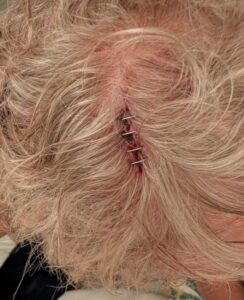
Here is the unsavoury photo of my head wound and staples. So follow these tips to stay safe, and never underestimate your vulnerability as a swimmer if you have no head protection!
The Warning Signs: “Busking”
Swans are fiercely protective parents. Mute swans are highly territorial, especially during the spring and early summer nesting season (April through June). The males will relentlessly defend their mate, their nest, and their cygnets. If you swim too close, they perceive you as a predator. While they usually give warning signs, if they feel their young are in immediate, unavoidable danger, they will escalate directly to a physical strike.
Swans rarely attack without telling you to back off first. You need to recognize their aggressive posture, known as busking. When a swan busks, it folds its neck back, arches its wings up like a sail to appear as large as possible, and propels itself toward you with synchronised kicks. This is almost always accompanied by a loud hissing.
Precautions and Avoidance
The best way to survive a swan attack is to not get into one.
Give a wide berth: If you see swans ahead, change your route to stay as far away as the waterway allows.
They will always busk or hiss first, before attacking. This is your opportunity to swim away and give them the space they want.
Never split the family: The absolute worst place you can be is in the water between a parent and its cygnets. Always swim *around* the entire group.
Avoid nesting areas: Reeds, shallow banks, and small islands are prime nesting real estate. If you hear hissing from the brush, turn back.
How to Manage an Attack
If the swan charges
1. Face the threat: Turning your back and furiously splashing away triggers their pursuit instinct and exposes the back of your head to a wing strike.
2. Back away slowly: Keep your eyes on the swan and tread water or backstroke slowly away. Smooth, calm movements are less threatening.
3. Make yourself huge: Raise your chest, lift your arms, and try to look like a larger predator. Swimmers are at a massive disadvantage because 90% of our body mass is hidden underwater.
4. Deploy your tow float: If you swim with a tow float, pull it between you and the bird. It acts as an excellent, buoyant shield against wing strikes and beak pinches.
Can You Scare a Mute Swan Away?
Yes, but it requires holding your ground and is very risky if you are swimming, as you are in a weak position below them. This is only a last ditch attempt if they are blocking your escape completely, and you can’t wait it out. If backing away isn’t working and the swan is actively attacking you, you have to dominate the space. Hiss back loudly. Stare them directly in the eye (a classic predator behaviour). A sudden, loud show of aggressive confidence can make them reconsider the fight. But, if they are blocking your route to land, and you absolutely need to get out of the water, this could be your only option. You could also swim underwater, away from them and towards land, to protect yourself.
Should you splash them?
No, splashing a swan can provoke an aggressive reaction. Splashing creates commotion that can be perceived as a direct territorial threat or an escalation of conflict, which aggressive swans react to by charging or attacking. Splashing and loud noises resemble the natural “busking” or charging behaviour swans use to drive away rivals, such as geese or other swans. This can trigger the defensive or aggressive response.
Swimming vs. Paddleboarding
If you regularly share water with aggressive swans, you might wonder if you are safer on a Stand Up Paddleboard (SUP). You absolutely are.
When you are swimming, the swan is looking down at your head. When you are on a paddleboard, you are standing five or six feet above the waterline, instantly registering as a massive, intimidating predator. Furthermore, a firm slap of the paddle blade flat against the water creates a loud, concussive smack that is almost always enough to scare a charging swan into retreating.
Daniel Start is author of Wild Swimming Britain, now in its third edition
1,000 hidden dips in the rivers, lakes and waterfalls of Scotland, England & Wales (£19.99)