
The best wild swimming spots in Cornwall
The River Fowey cascades down through dense, sessile oak woodland on the edge of Bodmin Moor. There are humid, aromatic glens, and the trees are draped with rare ferns, mosses, and ivy. This area, known as Golitha Falls, is home to otters, which live among the river roots, and bats, which sleep in the old mine workings and maybe even the ‘Beast of Bodmin’, thought to be a species of small wild cat similar to a puma. In 1995, a big cat skull was found in the woods and claimed as the final proof, although the skull turned out to be that of a leopard taken from an exotic leopard-skin rug and planted by a hoaxer.
Where the main path ends, at the beginning of a series of shallow falls, pick your way further down one of the narrow trails. Wagtails criss-cross the stream, and a small, gladed pool opens up a few hundred yards below, out of sight of any crowds. When I was there, the yellow sand of the stream threw up a golden light on the rocks around as I eased myself into the pool. It was hot, and I was tired, but the babbling moorland water soon cut through the sweat and grime. It wasn’t large or particularly deep, but the stream picked me up, and I found a part of the current which, with some careful balancing, held me in position as I swam. Then I flipped onto my back and let the flow carry me down into the shallow rapids and ground me in the sand, the water rushing over my shoulders and shins like a spa.
After a little doze in the dappled light of the rocky ledges, I found a wooded weir pool about another mile or so downstream and camped there discreetly. As dusk gathered around me, I sipped whisky and kept a silent vigil for bats and owls. As the evening drew late, I thought I saw the luminescent blurs of will-o’-the-wisp in the shadows of the wood before I fell asleep under the trees, looking up at the pale midsummer night sky, with total darkness never quite descending.
River swimming, Cornwall
Waking early, I had a quick splash in the water in bright sunshine before trekking back to the car. I was heading ten miles downstream for the National Trust estate of Lanhydrock House, a Jacobean country house built in the early 17th century by the Robartes family. It is now one of the Trust’s most visited properties. The gardens are filled with magnificent magnolia and camellia, and the estate stretches for many miles along the Fowey.
Downstream from Respryn Bridge, once the lowest crossing point on the Fowey, there are bankside decking areas which make a good place to change and swim. The water is fast-flowing and refreshing, about five feet deep in places and completely clear. I practiced some shallow diving and then swam along the bank, searching for otter holes and examining the oak roots that grow down into the water.
As the morning drew on, the path became busy with dog walkers and families playing Pooh Sticks, so I got dressed and headed upstream. This path is even more beautiful for swimming and arrives, bizarrely, at a white gate leading into the back of Bodmin Parkway Station car park. This was the terminus of the first steam railway in Cornwall, built to bring lime-rich sea sand from Wadebridge for use as fertiliser. A wooded stretch of riverbank here is home to a dark but magical stretch of the river, completely overshadowed by trees and foliage. I swam and floated several hundred yards downstream and then had to tiptoe back barefoot through the undergrowth and creepers to find my pile of clothes. Here, only a mile from the main line and the 08:36 to London, you can pretend you’re lost in a tropical jungle.
Cornish camping and wild swimming
Much of the wealth of the Robartes family came from mining, and the landscape is dotted with their pools and lakes. Often, they are old granite workings, but there are areas with relics from tin and copper too, such as at Caradon. One of the best-known pools is a turquoise quarry lake near Port Isaac, the old Tregildrans Quarry. The land has been in the same family for generations, but when the quarry went out of business forty years ago, the owner, Lizzie, decided to let it go wild, creating a network of forest clearings with tipis all around the lake, now called Cornish Tipi Holidays.
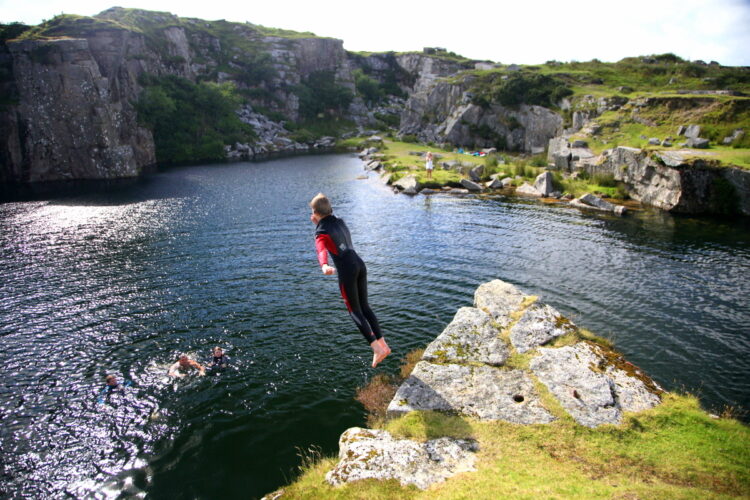
When I visited, the lake was alive with families swimming and having fun. Leaving my clothes in a heap, I dived in to join the melee, the late afternoon light shining through the leaves. The underwater zone felt white, opaque, and was flavoured with minerals. Almost before I had surfaced, someone dive-bombed me from a tree, and I raced for control of an abandoned lilo. At the far end of the quarry, a willowy boy stood alert at the prow of his canoe, searching for trout below. Later that evening, we prepared a small fire, and I retired to my tipi at the edge of one of the clearings. Towels were being hung out on the guy ropes to dry, swimming costumes adorned the totem poles, and I could still hear the sound of splashing from the lake. This is a little lost world of canoes, swimming, and Hiawathas.
Wild swimming on Bodmin moor
Those interested in legends should visit Dozmary Pool, where the ghostly hand reputedly appeared to take the sword Excalibur when the knight Sir Bedivere returned it to the lake. Whirlpools are said to rage here to this day. On top of Bodmin Moor on a sunny August day, clouds racing across the sky, Dozmary seems rather benign and the swimming a little shallow. The shores of Colliford, lying across the field, would provide a more satisfying swim, if it were permitted. This is Cornwall’s largest and highest lake. It is also situated close to the famous Jamaica Inn, setting for Daphne du Maurier’s evocative novel of smugglers and pirates, and now a mystical labyrinth, constructed using traditional Cornish hedges.
Wild swims near Tintagel
For more Arthurian legend, visit St Nectan’s ‘Kieve’ – a Cornish word meaning tub, vat, or natural basin – often used to describe circular or hollowed-out pools. Found in a hidden valley only a few miles from the Arthurian castle of Tintagel, St Nectan, the hermit who lived here in the hermitage around 480 AD, was one of the holiest of Cornish saints. Treading gingerly down the wet slate steps, I descended into the veil of mist that rises from St Nectan’s Kieve; it’s easy to see why this place was revered. The flow of the water has sculpted a deep cylindrical well and a perfect man-sized hole through which the water spills. This upper pool is out of reach, but the lower pool is deep enough for an exhilarating splash and plunge. This has long been a place of pilgrimage and immersion, and it was here that King Arthur’s knights were baptised before they set out on their quest to recover the Holy Grail. Today, small shrines of cairns and photographs of loved ones have been set up on the surrounding rocky ledges. Little light filters down here, but hundreds of coloured ribbons tied to branches and rocks give the cavern a fluttering glow, like a pagan May Day.
Ready to explore further? Discover more wild swimming and off-the-tourist-track places in the Wild Guide to Cornwall and Wild Swimming Walks Cornwall
2 thoughts on “Cornwall wild swimming”