Top wild swimming spots in Somerset
The mouth of the River Avon rises in the Cotswolds before winding down through Wiltshire and Somerset, enriching towns along its way, many of which harnessed the power for mills, such as at Bradford-on-Avon.
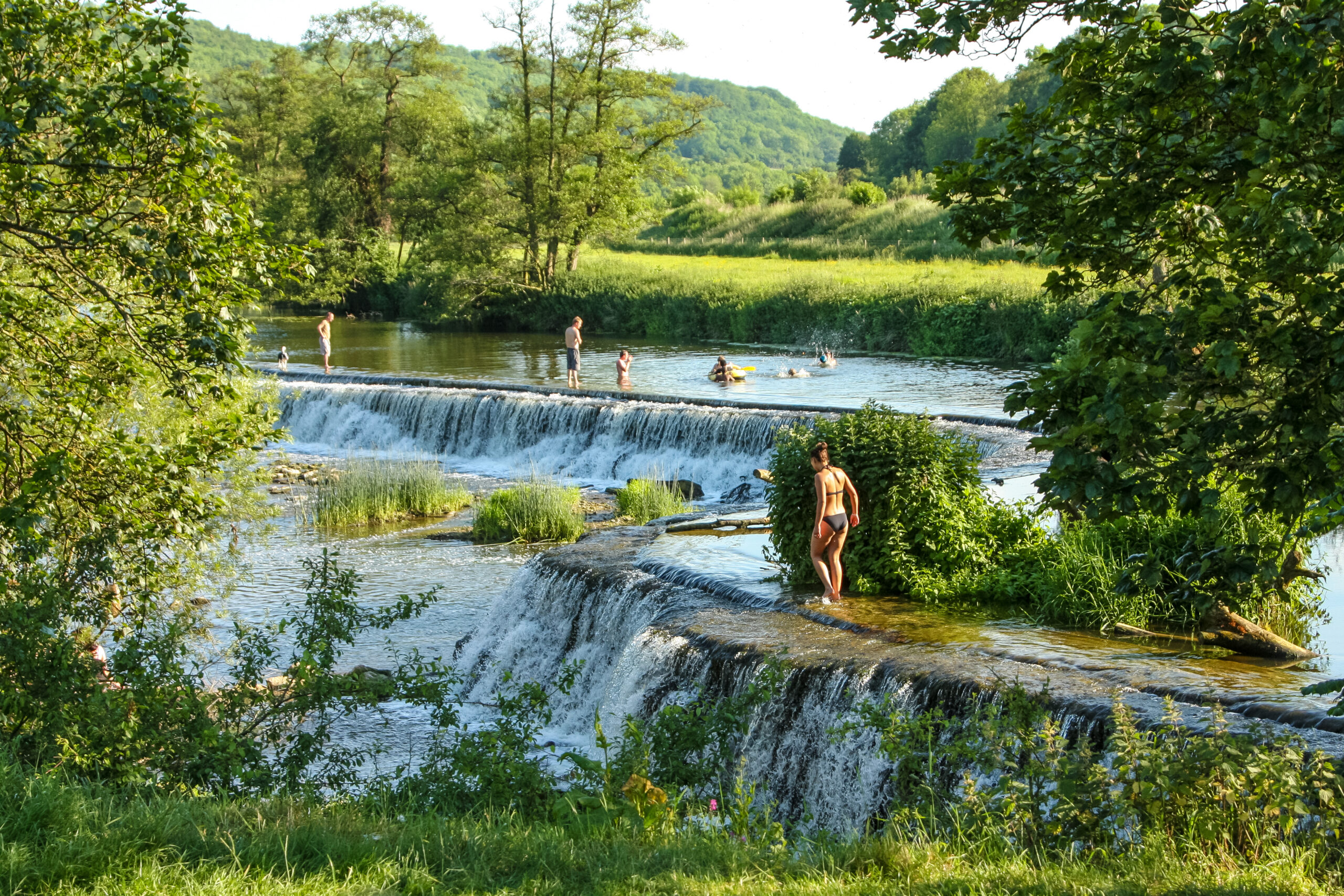
Warleigh/Claverton Weir, five miles downstream and on the outskirts of Bath, forms a long, meandering waterfall across the River Avon. The weir looks a little like a miniature Victoria Falls stretching into the distance. At over one hundred yards long, it was built in 1810 to power a pump that would lift water from the river to the nearby Kennet and Avon Canal. It has created a huge pool in the Avon and a spectacularly wide waterfall. Children play under the dam and in the shallows. Adults can take a long swim above the weir for the best part of a mile.
Spa waters in Bath
In Bath, a different water created wealth through the hot springs (which once also emerged in Bristol at Hotwells). The water fell as rain around 10,000 years ago and then sank to a depth of about 2km. Here, it is heated by high-temperature rocks before rising back up through one of the three hot springs in the center of the city: the Cross Spring, Hetling, or King’s Spring, which supplies the Roman Baths.
The actual source of the waters remains a mystery. It was believed that the source was in the Mendip Hills, 30 miles to the south of Bath, but more recent findings suggest that the rainwater enters through the carboniferous limestone closer to the city and the Avon Valley.
The Farleigh and District Swimming Club
The River Frome joins the Avon from south of Bath and definitely does come from the Mendips. This river is home to one of the country’s last surviving river-swimming clubs, with stories of camping galas and wild swimming parties. The Farleigh and District Swimming Club occupies a great sweep of south-facing meadow by an old diving frame and gravel-bedded weir pool on the Frome. With over 2,000 members, people come here from far and wide to experience real swimming and to sunbathe on the grassy banks.
The club was founded in 1933 during the great boom in British river swimming. The village was already popular with the people of Trowbridge, a few miles away, who would walk over to Farleigh at the weekend to swim, visit the castle, and have a drink at the Hungerford Arms. The four Greenhill brothers owned the farm on the opposite side of the bank and also loved to swim. One day, they invited some of these regular bathers to form a swimming club, and for the next 20 years, the club flourished. Summers saw a regular group who would camp out on the banks, rise at six for an early-morning dip, and then go off haymaking for the day. There were Wednesday evening swimming galas, great bonfires, and general summer antics, all with the enthusiastic support of the Greenhills. In more recent years, the club has swapped banks. The new landlords are just as enthusiastic, and they run a campsite and tea shop a mile upstream.
This river is a beautiful setting for a summer afternoon, with children swimming among the moorhens and alder roots, and the spray from the weir catching the floating dandelion seeds. There are no galas or bonfires here anymore, but the big-hearted welcome still exists.
Tellisford Weir
Two miles upstream at Tellisford, the landowners have also been modernising with a sensitive eye for wild swimmers. A beautiful weir pool is located a little way up from a medieval packhorse bridge among wide fields and an old Second World War bunker – this was a position on the ‘Salisbury West Stop Line’ where the British planned to defend the country against an attack coming from the south coast.
This weir was originally constructed in the eleventh century to power the village mill. Although it stopped working in 1912, the weir pool has been saved by a local project to generate 60kW from the renovated mill race – enough to power the whole village. This is an exciting green initiative that has preserved the weir pool, provides a more reliable supply of electricity than wind, and is less unsightly than a turbine.
Wild swimming Somerset Levels
If river music is your interest, then St Peter’s Church, set alongside the River Brue at Lydford, is noted for its choral tradition. While the Stour drains Dorset south to the English Channel, the Lyd drains the Somerset Levels west to the Bristol Channel. Dorothy, an energetic silver-haired woman in her 60s, has swum here since she was a child.
‘I loved listening to the choir practise as we glided past the blossoms in spring. It was like a natural baptism.’ The smell of ozone from the tumbling water and the swooping manoeuvres of the damselflies are sure signs of how clean the river is today.
Directly below the old weir is a small pool where children paddle and play. On warm weekends in the past, you might have found the neat lawns of the churchyard laid out with deckchairs and towels, and a mixture of swimmers and spectators of all ages jumping in from the bridge or swimming breaststroke back and forth along the blossomed reach, pulling themselves out between the two cherry trees, then sipping Earl Grey tea on the grass.
Sadly, access to the river has been fenced off from the graveyard due to anti-social behaviour during lockdown and parking problems, but you can access the weir from below and there’s a huge weir pool upstream through the meadows.
Somerset literally means ‘land of the summer people’ because the area could not be populated in the winter due to the great sea floods that inundated the levels. Lydford stands on the edge of this floodplain. From here, it’s only a couple of miles to Baltonsborough Flights, another swimming hole, where the river drops down a weir into a large pool before beginning its journey to the sea through the heady blossoms of cider groves, willow, and teasel.
Wild swimming on Exmoor
The main river on Exmoor is the Lyn, that drains the moor to the north coast. The upper reaches of the River Lyn’s east and west branches sweep through the peaceful Doone Valley, the setting for the famous novel Lorna Doone, and also Watersmeet, with its pools and waterfalls.
The rain can be extreme on Exmoor and Lynmouth was the site of one of the most devastating floods in British history. The River Lyn took on ferocious force on the night of 15th August 1952. An intense tropical storm rolled in from the Atlantic and dropped nine inches of rain on the already waterlogged moors. None of the rivers could cope, and banks burst all over Exmoor. At Hawkridge, the massive Tarr and in total, 34 people died. New evidence now suggests that the extreme weather events of August 1952 may have been a result of top-secret cloud-seeding experiments taking place at the time off the Devon coast.
Where to swim on Exmoor
The main attractions at Watersmeet, a Victorian fishing lodge on the West Lyn, now a quaint National Trust-run tea shop, are the simple waterfalls and woodland walks. Follow the river path a couple of miles upstream to the little-known Long Pool, a deep narrow gorge found in the woods beneath the path.
Further on, the path continues to Rockford, and before you get there, you’ll find several more pools with small cliffs to jump from. As I was exploring, I met two families kitted out with wetsuits and rubber dinghies. They had spent much of the afternoon playing in these shady pools and said it was more fun than being on the nearby beach.
Follow instead the East Lyn, upstream to Malmsmead, to discover the notorious setting of Lorna Doone: An Exmoor Romance by R. D. Blackmore, one of the bestselling books of all time. The church at nearby Oare is where the novel’s famous conclusion was set. This land of murder and outlaws has tumbling streams and dense woods. Wildlife abounds throughout the area. Red deer, ponies, and sheep graze freely, watched over by falcons, buzzards, and even the rare merlin.
Cloud Farm is a great place to stay, with pony trekking, a campsite, and river paddling in the Badgworthy, a tributary of the Lyn. But on a hot summer day, Deer Park Pool is the place to be, a mile further up the stream. As you come out of the woods and into an open grassland clearing, you’ll find a circular plunge pool flowing under a large ash tree. Although small, it’s deep enough for a good splash, as my friend Hue and his dog, Felix, demonstrated.
The path continues on and up to more Doone country on Brendon Moor, or you may prefer to return to the farm shop for one of their famous après-swim cream teas. Heather-topped hills, bracken-covered combes, tumbling waterfalls, and wooded river valleys prompted the Victorians to name the magnificent scenery and quiet charm of Exmoor the ‘Little Switzerland of England’. The ancient landscape of Iron Age barrows and hut circles on its high flat moors suggest it was popular with ancient man too, after the ice age. But Exmoor is now Britain’s least-visited National Park.
The best river swimming near Exmoor
To the east, the River Barle steals the show. An old friend, Hue, and his dog, Felix, had offered to take me to one of their swimming holes near Cow Castle, a prehistoric hill fort in the remote upper reaches of the valley. We met at Simonsbath, an auspicious-sounding place for the job at hand, and dropped down through Birchcleave Woods to the river.
The Barle runs in a narrow vale lined with bright orange asphodels for much of the two miles to Cow Castle. It is a shallow stream that twists and turns between avenues of birch and the ruins of old mine workings. As it reaches the conical hill of the fort, it deepens and slows into a pool. Swimming against the current of this small, buffeting stream was harder than we had anticipated, and soon we had a competition going to see who could beat the river and make it upstream. We then tried to out-swim the dog. Once we were all thoroughly exhausted, we ran up to the top of the castle knoll and collapsed on the grass, the wet dog panting and the evening sun glowing low.
From here, the course of the Barle winds its way another two miles before it reaches Sherdon Hutch and Landacre Bridge. These have long been popular Exmoor bathing and picnicking spots, with shallows by the bridge and a deeper hole at the confluence of the Sherdon brook upstream.
According to Hue, locals believe there is a hot spring somewhere along its course near here that makes the water especially warm. Perhaps the hot spring was broken the next day because the water was pretty invigorating at Landacre. Despite this, several families had taken up positions along the bank. At Withypool, a few miles further on, barbecues and picnics were in full swing, and a small flotilla of inflatable boats was in operation.
Secret wild swims, Exmoor
At Tarr Steps, there were even more people. The clapper bridge here is truly impressive. Constructed from megalithic flat stones laid end to end and propped up on boulders, it is one of the best-known monuments on Exmoor, and several theories claim it dates from the Bronze Age, although others date it to around 1400 AD.
One myth has it that the Devil built it to win a bet and swore he would kill anyone who tried to cross it. To test his curse, the villagers sent a cat across. That was promptly vaporised, so the terrified locals sent the parson across next. Although the Devil swore and intimidated him, the parson swore back, and finally, the Devil succumbed and allowed people to pass, except when he wanted to sunbathe. Between, above, and below the flagstones, children were chasing minnows, skimming stones, and getting thoroughly wet.
I decided to find some peace and headed upstream a couple of miles through the beautiful National Nature Reserve. The woods here are internationally renowned for their mosses, liverworts, and lichens, including a type of moss found in burrows, which appears to glow in the dark. They are also home to the rare barbastelle bat, which breeds in the cracks of old trees.
Feeling wonderfully relaxed away from everyone, I found a perfect pool, not too deep, some way down from a footbridge. Here, I swam, disturbed by no one, not even the Devil.
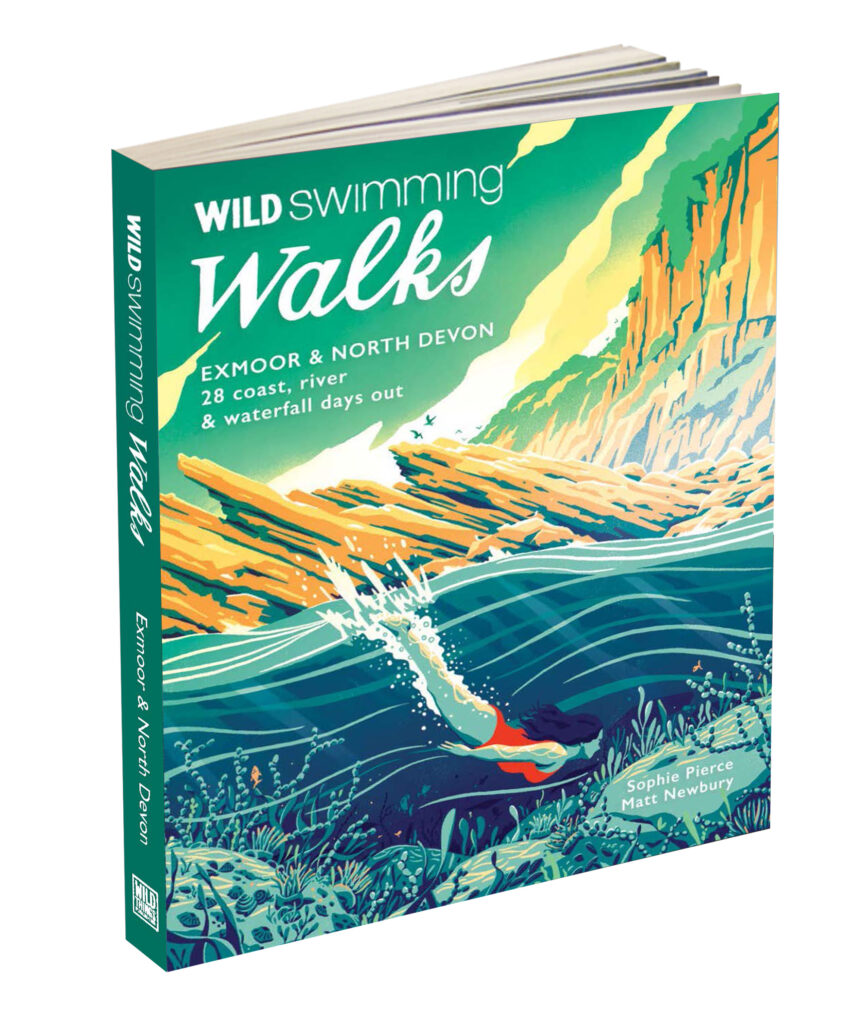
Ready to explore further? Discover more wild swimming and off-the-tourist-track places in the Wild Swimming Britain, Wild Swimming Walks Bristol & Bath and Wild Swimming Walks Exmoor and North Devon