From clear chalk streams and quiet river pools to historic water meadows and open countryside, Hampshire has a remarkable variety of places to enjoy wild swimming.
The county is particularly famous for its chalk streams. The River Test and River Itchen flow through some of Hampshire’s most beautiful landscapes, their clear, mineral-rich waters rising from underground aquifers and maintaining a remarkably consistent temperature throughout the year.
The best wild swimming in Hampshire
The wide braids of the River Test run through some of the least-developed parts of the South East. Wily and fast, the river winds its way through the most tranquil parts of Hampshire as it heads for the sea. Watership Down, the chalk downland immortalised by Richard Adams, is the headwater of the River Test. These were the hills down which Pipkin and Hazel fled, first from the bulldozers, then from Efrafan rabbit soldiers, before jumping onto a punt moored on the river at Laverstoke.
Paddling and Pooh Sticks
Like the Salisbury chalk streams, public access to the banks of the Test is rare, with fishing rights costing up to £1,000 per day. However, at Chilbolton Cow Common, near Chilbolton, there has been public access since ancient times.
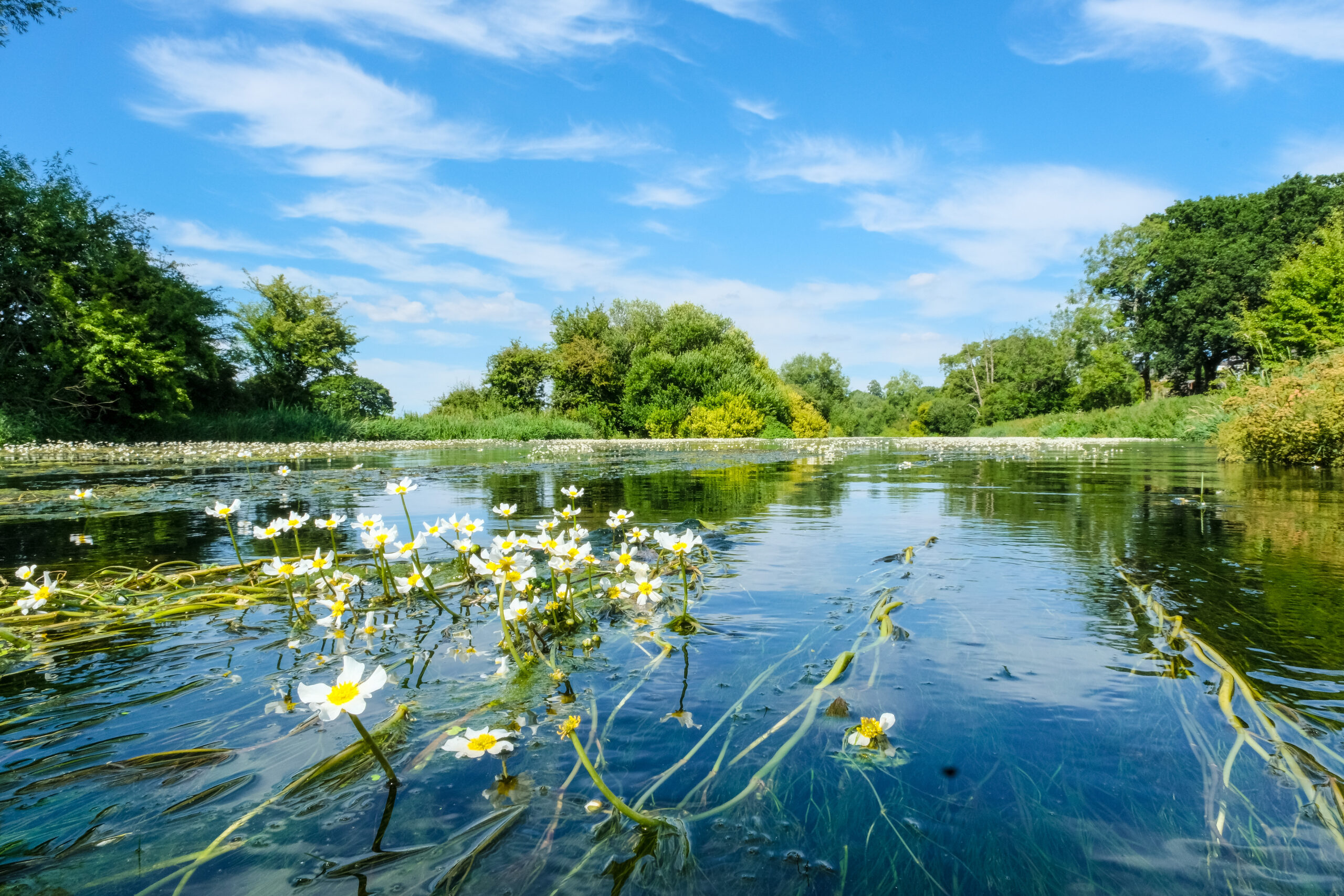
The little footbridges here are a magnet for families paddling and playing Pooh Sticks on a hot summer day. But as I arrived at seven o’clock on an early evening in June, the last picnickers were leaving. The clear waters of the chalk stream are home to many unique plants. As I dipped my toes in the shallow waters, it felt like bathing in an underwater flower meadow. The long fronds of yellow starwort rippled in the current like buttercups, and the white water crowfoot waved like daisies. The downland mineral water flowed through my hair and created rivulets around my fingers.
Swimming in the chalk streams of Hampshire
The chalk shingles of Hampshire’s streams were laid down long ago. Coral reefs and sea plankton collected during the landscape’s time as part of an equatorial archipelago millions of years ago. Back then, the water would have been a balmy 30°C, but the temperature now is far from tropical – a chilly 12°C. Rising from aquifers deep beneath the hills, the temperature remains remarkably constant throughout the year. Even on frosty winter mornings, the Test is relatively warm, famous for its steaming river mists. A bathe here feels almost balmy.
At Houghton, another favourite paddling location five miles away, a white shingle bay opens onto a large shallow pool under a bridge, where you can swim against the current. The old trackway crosses water meadows to John of Gaunt’s deer park and the ancient yews at King’s Somborne.
The river course has changed significantly in the last three hundred years. In John’s time, new channels were being cut for the creation of ‘floating’ water meadows. A system of sluices encouraged the river to flood the fields, nourishing the grass and protecting it from frost to enable earlier lambing and increased sheep stocking. It’s now difficult to determine which is the original river course and which is an old irrigation path.
Wild swimming in the River Itchen
Running through nearby Winchester, the Itchen is another chalk stream that has been much altered by man. It was deepened for barge navigation in the eighteenth century, facilitating barge transport between Winchester and Southampton, but most of it has returned to shallows.
Twyford Lock still remains – a deep pool beneath a small waterfall. It is one of the few surviving turf-sided locks in the UK. With their sloped grassy sides, they were cheaper but less durable than brick or stone designs. A path follows the Itchen all the way to Winchester, making for a pleasant two-mile walk, despite the noisy motorway overhead. The Twyford Downs, site of the road protests of the 1990s, are on your right, and you might like to take a dip in Tumbling Bay.
Eventually, you’ll reach the water meadows of St Cross, where there are also some deeper pools by the Hospital of St Cross in Winchester.
Water meadows, wild swims and picnics
Founded around 1136 by Bishop Henry of Blois, the Hospital of St Cross is England’s oldest charitable almshouse still in use. Established to care for elderly men and offer hospitality to travellers, it continues this tradition today with its ‘Wayfarer’s Dole’ – bread and ale given to any visitor who asks. The site features a magnificent Norman-style church and historic buildings set in peaceful gardens, all located beside the river and its water meadows.
For wild swimmers exploring Hampshire, the River Itchen offers the chance to combine a riverside walk with the history and beauty of one of England’s most remarkable chalk-stream landscapes.
South of Winchester, an open and pastoral section of this glorious chalk stream at Eastleigh is hidden behind a railway siding.
Ready to explore further? Discover more wild swimming and off-the-tourist-track places in Wild Swimming Britain, The Wild Guide London & South East & Wild Swimming Walks Thames and West