
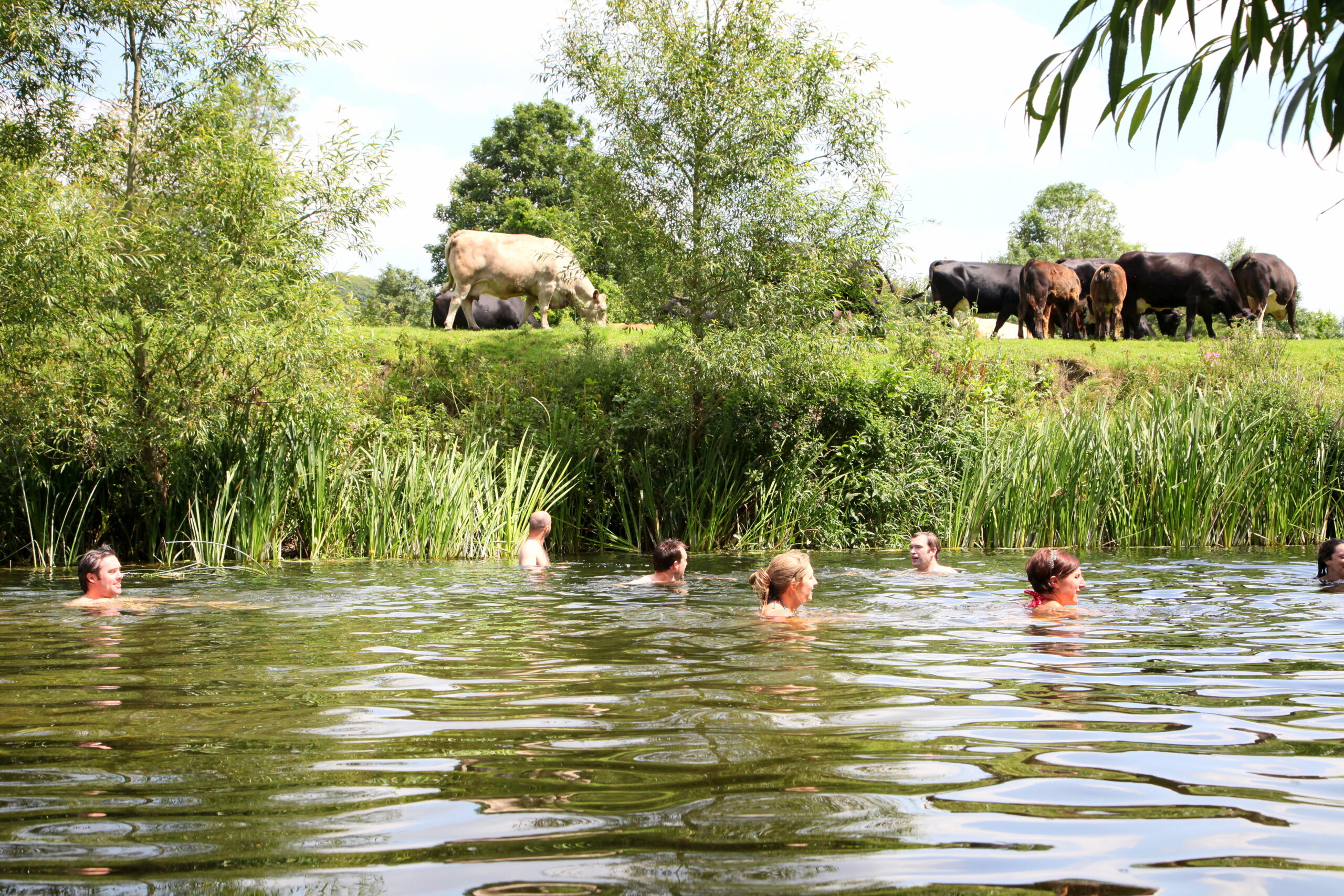
The young Thames is a quiet river, rising in the Cotswolds and flowing peacefully through the Oxfordshire plains. Distant church spires peek over billowing wheat fields, and wild flowers wave in the hedgerows.
Best wild swimming spots, Cotswolds
Three hundred years ago, things were a little busier on the upper reaches of the Thames. Lechlade was a bustling port, loading Cotswold stone and Gloucester cheese, and the new Thames and Severn Canal had just opened where the Round House now stands. But with the decline of the canals, more recreational pursuits took over. Lechlade became renowned for its water carnivals and swimming galas. The Ha’penny Bridge, built famously high to accommodate eighteenth-century sailing barges, was popular for diving competitions.
Though the organised activities have now gone, boys still jump from the bridge, and the area is still a designated Riverside Park, providing swimming and boating for hundreds on hot summer weekends. The open fields of the Riverside Park are a pleasant and convenient place to swim. But downstream, around Buscot and Kelmscott, the real beauty and charm of the Upper Thames begins.
At the Cheese Wharf in Buscot, once a loading bay for twenty tonnes of cheese a day, there is a rope swing and deep pool for swimming and diving. A mile or so on, past the graceful riverside gardens of the Old Parsonage and church, the old weir at Buscot has scooped out a deep and clear natural pool, lined with weeping willow. Swimmers splash about among the tendrils, appearing through the leaves that brush the water. The older children climb the low boughs and use them as platforms to jump in from, while the younger ones play among the deep roots and use them as handrails to pull themselves out.
This is a justifiably popular place for swimming. The National Trust lawns that border it are dotted with inflatable boats and deckchairs, and the lock keeper is tolerant as long as you stay away from the weir itself.
Further downstream is the honey-stone village of Kelmscott, once home of William Morris, the founder of the Arts and Crafts movement. By Chimney Meadows, bulrushes tower overhead like wheat in a children’s cornfield, and the wild flowers of Chimney Meadows, populated by wild grasses since Saxon times, break through: meadow barley, buttercup, crested dog’s-tail, lady’s bedstraw and bird’s-foot trefoil.
Pubs, ducks and ancient history – swimming in the Cotswolds
As you approach Oxford, the Windrush joins the flow, the idyllic Cotswold stream. In Bourton-on-the-Water, there are ducks and high street riverways, in Little Barrington, perfect riverside pubs, and in Minster Lovell, it flows past the remains of a fifteenth-century manor. Here, alongside the great old arches and ruined walls, you can bathe in the blue-tinged waters and catch crayfish big enough for supper.
The Evenlode is another beautiful river which runs parallel a little way to the north. It was at Stonesfield, famous for its honey-coloured stone quarries, that the first ever dinosaur remains were found in 1824. The Jurassic limestone dates back 160 million years to the time of the Megalosaurus, or the ‘Great Lizard of Stonesfield’, whose discovery changed the face of history. Dinosaur bones had, in fact, been found prior to the 1800s, but were thought to be the fossilised remains of some giant human, now extinct, or the bones of elephants brought to Britain by the Romans.
The river here is only shallow, but the vale through which it runs is beautiful, with sunny steep banks, a footbridge, pool and the remains of a Roman villa too. If you’re lucky and search the riverbed, you may even find your own dinosaur bones.
The best wild swimming in the Thames, near Oxford
The Thames, from Oxford downstream, has inspired generations of charming tales, from Alice in Wonderland to The Wind in the Willows. Meandering through rolling countryside and stone villages, these are some of the most civilised swims in England. In many places, the river is as unspoilt as it was 100 years ago, and a whole lot cleaner.
The Thames enters Oxford along Port Meadow, England’s largest and oldest continuous meadow, recorded in the Domesday Book of 1086. It has never been ploughed and is older than any building in Oxford. At the northern end, near Wolvercote, there is swimming under the bridge and beneath the weir, with grand views of the dreaming spires. This is the setting and inspiration for the opening lines of Alice in Wonderland, where Alice was ‘beginning to get very tired of sitting with her sister on the bank…’, and the closing lines, where Alice sees ‘an ancient city and a quiet river winding near it along the plain’. At the southern end of the Meadows, closer to the train station, the river has cut out little shallow beaches along its course, popular with families.
In early summer, it is awash with daisies, and by evening you’ll see flocks of lapwing and plover rising into the sky.
Parson’s Pleasure
Oxford has long been a wild-swimming university, and the dons established a naked bathing site on the Cherwell in 1852. Christened ‘Parson’s Pleasure’, one story tells how a number of dons were sunbathing on the banks when a group of students floated by in a punt. The startled dons covered their modesty, all except one who placed a flannel over his head, explaining: ‘My students know me by my face’.
A site just downstream for women – ‘Dame’s Delight’ – followed in 1934, but both were eventually closed in 1991. All that now remains of Parson’s Pleasure is a beer named in its honour, but you can still swim nearby.
River swims, literature and picnics, near Oxford
Three Men in a Boat, Jerome K Jerome
Towards the end of the nineteenth century, the river downstream of Oxford had already become a playground for London society. Clifton Hampden, six miles south, was a favourite with Jerome K. Jerome for boating trips.
‘Sometimes we would fix up a trip of three or four days or a week, doing the thing in style and camping out.’
In 1888, he wrote Three Men in a Boat, which became a manifesto for a simpler way of living with nature – river swimming before breakfast, kippers after and a snooze before lunch. Today, the long grass and river banks are set against billowing hay fields, and the area is a wonderful piece of bucolic tranquility close to London.
The Wind in the Willows, Kenneth Grahame
Below Reading, the river is still clean enough for swimming. The stretch between Hurley and Marlow is the inspiration for much of Kenneth Grahame’s The Wind in the Willows. This is where Ratty spent so much time swimming with the ducks, and Mole so much time trying not to fall in. Kenneth Grahame’s own childhood was spent with his grandparents, being rowed out to little islands and other riverside haunts near Cookham Dean. Toad’s dungeon is based on the Ice House in Bisham Woods, and Badger’s Wildwoods is based on the Quarry Woods nearby.
Grahame moved to live by the Thames after his retirement from the City in 1908. He was probably the most unlikely – and most unhappy – money man ever appointed to the post of Secretary of the Bank of England. But within months of his early retirement, he had written The Wind in the Willows. ‘As a contribution to natural history, the work is negligible,’ The Times wrote stiffly. But Grahame’s fable has become one of the best-loved works in literature.
Ready to explore further? Discover more wild swimming and off-the-tourist-track places in Wild Swimming Britain, The Wild Guide London & South East & Wild Swimming Walks Thames and West


3 thoughts on “River Thames, Oxfordshire & Cotswolds”