

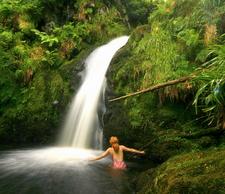
Not being able to swim – sounds obvious but shallow water can deepen suddenly. If you, your children or your friends cannot swim make sure you scout out the extent of the shallows, set clear boundaries and keep constant supervision. Remember that even shallow sections of fast-flowing water can knock you off your feet. Be careful with inflatables, which can create a false sense of security and float off into deep sections or burst. Buy a good quality buoyancy aid for non-swimmers (about £40) and, best of all, learn to swim. Not being able to swim as well as you think is also a killer, especially in cold water…
Cold water and Hypothermia – outdoor swimming in cold water saps body heat, reduces swimming ability / range and impairs judgement. Shivering and teeth-chattering are the first stages of mild hypothermia, so get out of the water and warm up with a combination of warm, dry clothes and activity. Press-ups, star-jumps and running up a nearby hill are the quickest! Wear a wetsuit if you want to stay in for more than a quick dip. Cold water reduces the ability to swim well by changing the body position in the water (more horizontal as the body tries to keep the head up) and contracting muscles (stroke positions of hands and arms becomes less efficient). Generally assume you can swim only one tenth of the distance in cold water as you can in a warm pool. Reduced swimming capability is the major cause of drowning, particular in lakes where swimmers may attempt to reach the other side, and the weakest in the group may become detached and drown at the rear, far from shore and out of sight of help.
Cold-shock – the involuntary gasp / inhalation reflex and rise in heart rate that occurs as the unacclimatized body enters very cold water. Test the temperature and wade in slowly unless you are already acclimatised to outdoor swimming. If you like jumping, and suddenly from a height into deep still water (like a deep lake) the lower layers may be much, much colder than the surface layer, leading to a cold shock reaction under the water, potentially fatal. Always acclimatise before jumping.
Slipping on rocks – One of the most common dangers in outdoor swimming. Rocks are very slippery when wet and you don’t want to hit your head. Never run. Go barefoot to get a better grip or wear plimsolls with a rubber sole. If you enjoy more serious scrambling along rivers why not join a gorge-walking or canyoning (canyoneering) course? A head injury while in or near water could be fatal if you pass out in the water.
Jumping and diving – Always check the depth of the water, even if you visit the same spot regularly. Depths can vary and new underwater obstructions (sand, rocks, branches, rubbish) may have been brought downstream or tipped in. A broken neck from a diving accident could paralyse you for life. Do not jump into the landing area of a large waterfall, the undercurrents directly below a large waterfall or weir could hold you under and you may not surface. Do not jump if you are not acclimatised to cold water (see above)
Cramps and solo-swimming – Swimming cramp can occur in the calf or foot and tends to be caused by lack of salt, overexertion, over-stretching and tiredness. Cramp is not more likely after eating but dehydration, or a poor diet in general, can make you especially prone. Generally you will know if you are susceptible to cramp, but not always. If you get a leg cramp, shout for help, lie on your back and paddle back to shore with your arms. Swimming alone in deep water is foolish but, if you must, wear a life jacket or trail a float behind you on a cord.
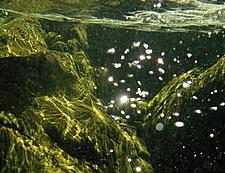
Weeds – Most common in slow, warm lowland river swimming and lake swimming, weeds are quite easy to see and, while one or two aren’t such a problem, a spaghetti-like forest could entangle a swimmer’s legs and cause panic. Try to avoid them. If you do encounter some, slow your swim speed right down, don’t kick or thrash, and either float on through using your arms to paddle, or turn around slowly. Generally it is the panic that drowns a swimmer, rather than the weeds themselves.
Blue–green algae – In lowland lake swimming, after warm, wet weather, usually in late summer, algae can multiply and a powdery, green scum (the blooms) can collect on the downwind side of a lake. It’s obvious and unpleasant and can give you a skin rash or irritate your eyes if you bathe in it, and make you sick if you swallow it. Find a part of the lake without blooms or go somewhere else.
‘Swimmer’s itch’ (cercarial dermatitis) – can be caught from contact with little snails that live on the reeds around marshy lakes and stagnant ponds. It is rare and creates a temporary but sometimes intense itching sensation that can last for up to two days. It’s not common, and requires no treatment, but it’s best to avoid wallowing in the bogs when outdoor swimming!
Weil’s disease – In urban areas sewers and storm drains may harbour colonies of rats whose urine may carry the bacterial infection Leptospirosis. Never swim in urban rivers, particularly canals, and be particularly cautious after heavy rains. If you are concerned about water quality cover any open wound with a waterproof plaster and keep your head (eyes, nose and throat) out of the water as much as possible. If you get flu or jaundice-like symptoms three to fourteen days after swimming in high risk water ask your doctor for a Leptospirosis test. It is simply treated with antibiotics but if left it can develop into the more serious Weil’s disease, which has been known to kill.
 Moving water and currents
For more on coastal currents click here.
Lots of our best water moves and river swimming in and against a current can be fun, just like swimming in seaside surf. However, you generally want to avoid being taken downstream in an uncontrolled manner. Even shallow water, if it’s moving fast enough, can knock you over and carry you away. Always consider: if I do lose my footing or get swept downstream, where will I get out? Identify your emergency exits before getting in and scout around for any downstream hazards (obstructions, waterfalls or weirs).
Beware the dangers of swimming above or near to waterfalls, and then being swept downstream and over the waterfall.
When judging flow rates remember the basics: the shallower or narrower the river bed becomes, the faster the water must flow to pass through, and vice versa. That’s why ‘still waters run deep’. Throw a stick in the water to judge flow speed and avoid anything moving faster than you can swim. In tidal estuaries there can also be counter-flows, with seawater moving in and river water moving out. In deep rivers or gorges the water in the surface layer may be flowing more slowly than the water beneath. These confused waters aren’t necessarily dangerous or outdoor swmiming – you’re not going to be sucked under – but they can be disorientating and may take you out into deeper water or close to an obstruction. You can generally feel what’s happening under the water with your feet and body. Large eddies and surface ‘simmering’ also suggest something more powerful is happening beneath. Be particularly cautious in these unpredictable waters.
Currents can be especially powerful directly under large waterfalls or weirs. As with breaking waves the water can be flowing in two directions, with some water exiting from the fall downstream while some creates a ‘rip-tide’ that is circulating to the back of the fall. Semi-circular or ‘box’ weirs, which have three sides, create particularly dangerous re-circulating currents in the confined space within their walls. In a large plunge pool you’ll generally feel the currents long before you are in danger of being pulled under the waterfall but if you are foolish enough to swim into the tumult, and are taken down, it’s like being caught in a wave’s undertow. Keep calm, hold your breath, hope you don’t get dragged along a rocky bottom and wait a few seconds until you are spat out. If you live through this and want to know more about the extreme sport of river swimming in wild rivers, riding river currents then search online for river boarding, hydrospeed or whitewater sledging.
So is wild-swimming dangerous?
About 400 people drown every year in the UK, but only a tiny percentage of these drown while outdoor swimming. An analysis of recent annual accident data shows that of the 12 per cent of drowning victims who died while actually swimming, 7 people drowned in swimming pools, 11 in the sea, tidal pools and estuaries, and 7 in rivers, lakes, reservoirs or canals. In addition there were 8 who died swimming drunk, 30 who died through ‘jumping in’ to water and 17 who died in ‘jumping and diving accidents’. 95 per cent of all swimming drowning victims were male and many were teenagers. (Sources: Royal Society for Protection of Accidents 2002 data; River and Lake Swimming Association; Jean Perraton in Swimming Against the Stream)
You can also read a little more about this at the Safe Watersports website.


Trackbacks For This Post
25 reviews

Good day I am so glad I found your blog page, I
really found you by accident, while I wwas looking on Google for something else,
Anyways I am here now and would just like to say many thanks for a remarkable post and a all round enjoyable blogg (I also love the theme/design), I don’t have time to read it all at
the minute but I have book-marked it and also included
your RSS feeds, so when I have time I will be back to read a great deal
more, Please do keep up the awesome jo.-
I have been surfing on-line more than 3 hours nowadays, yet
I never discovered any fascinating article like yours.It’s lovely value enough for me. Personally, if all site owners and bloggers made excellent content as
you probably did, the internet can be much more helpful than ever before.-
For the reason that the admin of this website is working, no question very quickly it will be famous, due to its quality contents.
-Great information. Lucky me I came across your website by accident (stumbleupon).
I’ve book-marked it for later!
-Greetings from Florida! I’m bored to death at work so I decided
to browse your site on my iphone during lunch break.
I love the info you provide here and can’t
wait to take a look when I get home. I’m surprised at how quick your
blog loaded on my mobile .. I’m not even using WIFI, just 3G ..
Anyhow, wonderful site!-Do you do link building for your personal website?
Many people say to stop with that anymore
Added this on FB wall, very interesting!-Hi there I am so excited I found your blog, I really found you by mistake, while
I was researching on Askjeeve for something else, Anyhow I am here now and would just like to say kudos for a fantastic post and a all round thrilling
blog (I also love the theme/design), I don’t have time to read it all
at the moment but I have saved it and also included your RSS feeds, so when I have time I will
be back to read a lot more, Please do keep up the excellent jo.-A person necessarily assist to make seriously posts I’d state. That is the very first time I frequented your website page and so far? I surprised with the research you made to create this particular submit extraordinary. Magnificent activity!
-Why visitors still make use of to read news
papers when in this technological world everything is available on net?-When someone writes an post he/she keeps the plan of a user in his/her mind that how a user can know it.
Thus that’s why this article is outstdanding. Thanks!-Excellent beat ! I would like to apprentice at the same time as you
amend your web site, how can i subscribe for a blog site? The account
aided me a acceptable deal. I had been tiny bit familiar of this your broadcast offered vivid
clear idea-[…] more tips for wild swimming safety inland and for sea swimming […]
-Awesome! Its truly amazing article, I have got much clear idea about
from this paragraph.-Hey are using WordPress for your site platform?
I’m new to the blog world but I’m trying to get started
and create my own. Do you require any html coding knowledge to
make your own blog? Any help would be really appreciated!-I every time emailed this webpage post page to all my contacts, because if like to read it afterward my contacts will too.
-I received my Basic Small firefall http://www.firefallstore.com found in dreary about Mar In 2010 there’re so decent I just used individuals almost everywhere! I wish I was able to bring in it during the summer time and yet my personal fett obtain also sexy:( Passes away . I actually have along with my personal firefall http://www.firefallstore.com is it occasionally is a bit really hard all of the jump on and then out of a base, nevertheless its primarily from time to time.. That see sort of strange.
-Rope makers appear to take pleasure in confusing us with science and/or extraordinary polysyllabic names.
Allow me to try to cut through the guff just a bit of.-Hello there I am so happy I found your site, I really found
you by error, while I was looking on Google for something else, Anyhow I am here now and would just like to
say thank you for a fantastic post and a all round thrilling blog (I
also love the theme/design), I don’t have time to look over
it all at the minute but I have book-marked it and also added your RSS feeds, so when I have
time I will be back to read a lot more, Please do keep up the excellent work.-It is perfect time to make some plans for the longer term and
it’s time to be happy. I’ve learn this put up
and if I may just I want to recommend you some fascinating things or suggestions.
Perhaps you can write subsequent articles relating to this article.
I desire to read more things about it!-I have read so many content concerning the blogger lovers however this post is
really a pleasant article, keep it up.-[…] works its magic even better. For other safety tips on open water swimming in the wild, read the health and safety tips of Wild Swimming. End of safety […]
-Fundamental principles of watch that it’s possible to cash in on beginning today.
-[…] River Safety […]
-[…] River Safety […]
-Was just swimming in the river nore county Kilkenny Ireland today triathlon training. Now I understand what cold shock really is,it was freezing!
Enjoy the tri season all!!!
-i love the way how they give information about dangers and rocks
-Every weekend i used to visit this site, for the reason that
i want enjoyment, since this this web page conations in fact good funny data too.-Many thanks for posting “River Safety | Wild Swimming – outdoors in rivers, lakes and the sea” http://guoguo.
me . Imight surely be coming back for more browsing and writing comments in the
near future. Many thanks, Joe-It seems like u know quite a lot pertaining to
this issue and that shows throughout this unique post, named
“River Safety | Wild Swimming – outdoors in rivers,
lakes and the sea”. Thank you -Gene-[…] As a child I used to swim in the Avon, near the Meadows (opposite the fire station). I don’t know if anyone still does. In any case it’s worth looking at the Wild Swimmingsafetyguidelines […]
-Follow Us!


Wild Swimming Books






Wild Guide Books














[…] more tips for wild swimming safety inland and for sea swimming […]
[…] works its magic even better. For other safety tips on open water swimming in the wild, read the health and safety tips of Wild Swimming. End of safety […]
[…] River Safety […]
[…] River Safety […]
[…] As a child I used to swim in the Avon, near the Meadows (opposite the fire station). I don’t know if anyone still does. In any case it’s worth looking at the Wild Swimmingsafetyguidelines […]